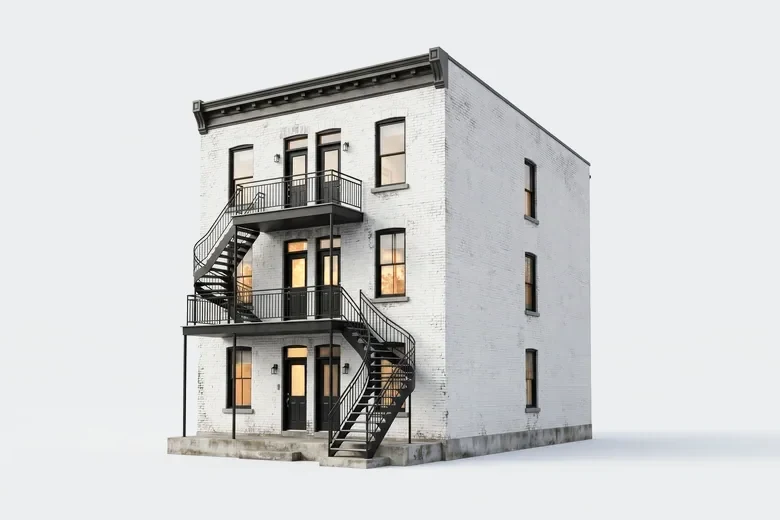

If you live in one unit of your plex and rent out the others, your insurance covers the building, your belongings and your liability, but generally not your tenants’ belongings. As a landlord, you also have obligations toward them. Here is who insures what, what the law says and what to declare to your insurer.
For the coverages specific to a duplex or a triplex, also read our guide for duplex and triplex owners.
Who insures what in a plex you live in?
You insure the whole building, your belongings and your liability; each tenant insures their own belongings and liability. The two policies work together, and one doesn’t replace the other.
| What is at stake | Your owner-occupant policy | Each tenant’s insurance |
|---|---|---|
| The building, all units included | Yes, depending on the coverage chosen | No |
| Your furniture and belongings | Yes | No |
| The tenant’s belongings | Generally, no | Yes, if insured |
| Your civil liability | Yes, up to the amount provided | No |
| The tenant’s liability, for example for water damage they cause | No | Yes, if insured |
| Rent lost after a loss | If the policy provides for it | No |
Policies vary: have the representative confirm each line. JuridiQC, a Government of Québec site (in French), notes that a tenant’s insurance generally covers them if they lose their belongings in a fire or water damage, if they are robbed or if they accidentally damage someone else’s property. Our tenant insurance guide explains what your tenants can take out.
What are your obligations as a landlord under the Civil Code?
You must deliver the dwelling and keep it in good repair, fit for habitation and clean, provide peaceable enjoyment and make the necessary repairs, as the Tribunal administratif du logement (TAL) summarizes.
The main obligations, according to the TAL:
- deliver the dwelling on the agreed date in good repair, fit for habitation and clean (arts. 1854, 1910 and 1911);
- provide peaceable enjoyment of the dwelling for the whole term of the lease (art. 1854);
- make all necessary repairs, except minor maintenance repairs, which are the tenant’s (art. 1864);
- comply with the laws on safety, sanitation, maintenance and habitability (art. 1912);
- not change the form or the destination of the dwelling (art. 1856).
These obligations affect your insurance too. Poor maintenance can cause a loss, and the lease can’t release you from them: the Civil Code of Québec (official codification, in French) makes a clause without effect if it limits the landlord’s liability or makes the tenant liable for injury caused without their fault (art. 1900).
Living in the building helps you spot a leak or a breakdown quickly. To enter a unit to check its condition or do work, give 24 hours’ notice, except in an emergency (art. 1931). The TAL specifies that for a major leak in the pipes, urgent work can be done without notice.
Can you require your tenants to be insured?
The law doesn’t require tenants to have home insurance, but the lease or the by-laws of the building can require it, JuridiQC states. TAL decisions show that the timing and the wording of the clause matter.
Two decisions summarized by the TAL on its page of decisions on the conditions of the lease:
- In 2019, the TAL ruled that a by-law clause, signed by the tenant, requiring them to hold liability insurance couldn’t be declared illegal. The tenant had to take out insurance and provide proof.
- In 2022, it refused to let a landlord add such a clause to the by-laws during an application to fix the rent. It saw it as a disguised rent increase.
The Civil Code also makes abusive a clause that imposes an obligation on the tenant that is unreasonable in the circumstances (art. 1901). These summaries don’t say how to write a valid clause: check with the TAL before adding an insurance requirement to a lease.
What happens when water damage spreads from one unit to another?
Each insurance plays its part: yours for the building and your belongings, the tenant’s for their belongings. Then liability depends on the cause, and the insurer that paid can turn against whoever is responsible.
What the Civil Code provides:
- The tenant must make good the injury caused by losses to the dwelling, unless they prove the losses aren’t due to their fault or that of the people they allow in. For a fire, they are liable only if their fault, or their guests’ fault, is proven (art. 1862).
- The tenant must notify you within a reasonable time of a substantial defect or deterioration (art. 1866).
- The tenant must allow urgent repairs needed to preserve the dwelling or its enjoyment (art. 1865).
- The insurer that paid is subrogated to your rights against the person who caused the injury, up to what it paid. It can never be subrogated against members of your household (art. 2474).
If you don’t act in time, the TAL explains that a tenant can carry out an urgent and necessary repair after trying to reach you, and be reimbursed for reasonable expenses.
After water damage, in practice:
- Have the water stopped and limit the damage.
- Notify the tenants affected and suggest they contact their own insurer.
- Report the loss to your insurer as soon as you know of it (art. 2470).
- Take photos and keep the receipts.
Is rent lost after a loss covered?
Only if your policy provides for it. When a unit becomes uninhabitable after a loss, ask the representative whether your policy pays for lost rent, for what amount and for how long.
Think about the unit you live in too. If you have to stay elsewhere, your extra costs fall under another coverage, which the representative can describe. And check the deductible of each coverage: our home insurance deductible guide explains its effect.
What do you need to declare to your insurer?
Anything that can materially influence the insurer: before you sign, the circumstances you know of (art. 2408); during the policy, promptly, those that increase the risk (art. 2466).
For a plex, that includes:
- the number of units and the one you live in;
- how each unit is rented;
- a unit offered to tourists for 31 days or less: according to the CITQ, only the unit you live in can be registered as a principal residence, and the others fall under the general category;
- a business, an office or a workshop in the building;
- major renovations: see which renovations to declare to your insurer;
- a unit that stays empty: ask from when your policy wants to know. For a residence, the law provides that being unoccupied for 30 consecutive days or less doesn’t increase the risk (art. 2468).
Once told about an increased risk, the insurer can cancel the policy or propose a new premium, to be accepted and paid within 30 days (art. 2467). A false or incomplete declaration can reduce the indemnity, or even lead to the policy being annulled (arts. 2410 and 2411).
How do you get offers for your plex insurance?
Describe your building once in a plex insurance request: the number of units, the one you live in and how the others are rented. Partner firms, whose representatives are certified by the AMF, make you their offers.
Compar Assurance is a matching service: it sells no insurance and gives no prices or advice. To keep up with recent changes to housing law, also read our guide to Quebec’s new housing law.
This guide gives general information. To know what fits your situation, talk to a certified representative.